Elk Bellows savaged the transportation planners when he proposed in the 1970s to bomb bridges around Denver’s core to relieve the car congestion that was exploding. This satiric piece penned like Jonathan Swift’s “A Modest Proposal” established his reputation for biking alternatives that avoided the destruction of the urban architecture by the ever careering automobile. He bicycles the Baker pavements in Denver, gardens past time, and writes with attitude about his experiences.
Ciao ragazzi!
MARCH 3, 2025

elk bellows emerges from the right side of MEATS lightbox in the current Month of Photography show at Altieri Studios 1 Galapago Street. Photo prints of trees from around the world and sequestered squirrels from 2018 surround the three pages that comprise the Prologue to Naïve Son, which is published here for the first time, in anticipation of chapters to this memoir rolling out over the upcoming months. Visit the studio on March 7, 14, or 21, 2025 for the immersive experience.
“Native or Naïve”… one who knows versus one who cares. Naïveté is a genuine form of native intelligence.
My single mother hired Zoro to care for me as an infant, while she worked to provide for her family of four children. Mother, the ever-independent Evelyne, moved to Denver to escape poverty and oppression, although she wouldn’t see it that way. She should have been defined by her family tree, but once she left Chicago in 1946 after the death of her first husband, Mother’s pioneering story took place across the mobile West where people abandon their roots to pursue opportunity; she gained a foothold in Las Vegas, New Mexico, before standing quick and tall like a Ponderosa Pine in Denver. Independent Evelyne left her in-laws behind. She wasn’t a native, nor were my sisters, but I am. Native means I am conscious of this place, this Denver, not indigenous per se, like the Ute, Cheyenne, and Arapahoe. The genius loci, the spirit of place, became my natural coefficient.
Too often, people don’t recognize the sacred aspect of their place of birth, regardless of their success or subjugation: how that origin point identifies them. Streamside cottonwoods like those along the High Line Canal qualify as native trees on the high plains. I was like a big Populus sucking what water was available. I would have dried up without the steady stream of my mother’s aspirations for me, born to a place that thrives on Rocky Mountain spring water.
Richard Wright and James Baldwin neither succinctly nor quietly explained their takes on “Native Son,” but the title was clearly used to proclaim the stature of African Americans in bondage, alas canvasing, stretching, framing American society. Slaves were stolen to build the Southern economy; after Reconstruction, blacks moved North for jobs only to find themselves confined to ghettos. American Indians were relocated by the likes of President Grant, a Civil War general, to reservations to make room for white settlers in the South. Plenty of tears were shed on these immigrant trails. Native populations were removed from their lands, and became slaves to the system.
Mother converted the parlor and study downstairs in the house into bedrooms, and turned the upstairs into an apartment to rent to soldiers returning from World War II. My deserting dad first called her landlady. He swore to cherish her and protect her, but he treated his Evelyne like an ignoble native. Before I was a year old, he left my mother; she sold half the land around our house to support her family. Love and tenderness, respect and land were stolen from her. He deserted his second family, and as I have found out, never served in the armed forces. Not a man for obligations to kin or country.
Albeit I’m a native Denverite, seldom am I recognized as such. Strangers don’t see me in the de rigueur uniform of cargo shorts, plaid shirt, and fleece vest, or roaming the hills till my heart’s content. When Dynasty was all the rage in the early 80s, and Denver vied with Houston as an oil boomtown, I gardened in lieu of drilling. After work hours I wore sharkskin suits and skinny ties in my mod revival, courting my wife-to-be who lived in Boulder. I owned my outsider status as an educated Jesuit boy bound for glory on the Shotgun Express out of Chicago. After the oil shale bust, Denver wore her cowtown heart on her Rockmount sleeve as she climbed the ladder of livable places, inducting the creative classes and tech startups. Through its Wild Chipmunk ride, the city often felt as much the handsome loner as I have, which I have refused to admit until now.
As for naïve, it is the French feminine form of “naïf.” As long as women have been ignored for their art or intellect, naïve has been associated with ineffectual practicality. I think naïveté is a genuine form of native intelligence. As a “Naïve Son,” I rank myself as a native who has approached life with a panoramic perspective. My life in Denver has granted me accommodation, assimilation, and a chance to succeed as a curious generalist, without an immovable identity.
This is auto-fiction, an autobiographical first and foremost novel, an episodic memoir ala Notes of a Native Son, but I call it Naïve Son: Coming of Age in the Metro West. The nativity of this fortunate son blocked the stage where I delivered the Post and telegrams on bicycle, drove spikes for the Colorado and Southern railroad, apprenticed as a taxidermist, gardened professionally and designed landscapes; where I saw and heard the cool bands, and pogoed my way through revolutions in rock, jazz, and world music; where I lectured at art school of literary movements and the rigors of writing. The stories can be docked like successive catches of city squirrels, from the high branches of academia down to the mud-soaked river bank roots of confessional poetry.
These are the notes of this “Naïve Son,” who cares to turn you on to the city’s mannerisms through a rendering of his own foibles and fortes. These memoirs let slip my life through jottings, epistles, sermons, and stories about songs, trips, relationships, sorrows suffered, loves supreme. Memories evoke emotions. I the protagonist exist as a scaffold of characters erected in analogous styles. Neither am I Pip nor Holden, neither Isabel Archer nor Janie Starks; I am a Denver native resurrecting his youth, retelling his past, representing his personas, and defining his present through his written memories of Denver beyond Kerouac and Cassady. Neither famous nor fatuous, here is a fellow who has worked his whole life and reflects on whether it made a difference. You decide whether I’m a custodian of culture. The soup is getting cold.
Album Cuts
Musical Musings by dj Eviscerator
The life of Elk Bellows in music – a Spotify playlist:
https://open.spotify.com/user/hsq5i2ogy1psx28ds9wxwgvsy/playlist/0opArkqnlFh74axrOOoXMc?si=SY38QgYdS765aZOZEQdzIA
What’s So Funny – the last encryption before the pandemic from “Mix Tape Letters”
He searches the stacks at every flea market and record store he visits, looking for a decent copy of Natch’l Blues by Taj Mahal. The reason he can only imagine, he traded his soon after college, when he was travelling light – he thinks he wore the grooves out, but now hears in his head “She Caught the Katy and Left Me a Mule to Ride” every few days, and finally in person Denver Botanic Gardens with his hard-headed woman during rainstorm. Keb Mo and Taj finally treat the audience to acoustic set after the roadies cover and uncover the equipment through waves of summer rain.
He had already seen blue King Krule, Archy the cockroach, at Ogden in April, talking his “Easy Easy” like post punk Mose Allison.
He thinks his granddaughter might be old enough next year to wander the blocks of South Broadway on Saturday or Sunday afternoon, pickin’ out the tunes.
The girl lead of Ghost Tapes carries him away later that night.
When the music died for a year, she buys him last minute tickets for David Byrne at Red Rocks, and they take a bus from Cheeba Hut on Colfax, basking on hot summer night in vapors, and vodka of road trip. The concert astounds him in staging, surreal romp of drum and bugle corps, choreographed inside the volume of shimmering silver box, like new wave Ricky Ricardo show; “This Must Be the Place” suits him as his own naïve melody. So glad she made them buy the tickets.
They had seen Angelique Kidjo at the DBG just weeks before where she turned Remain in Light into revolutionary manifesto, where for “Once in Lifetime” you’re not just passing.
He attends ESU conference in New Orleans and seesaws between Rachmaninoff and street blues. The Sunday post Thanksgiving yields gift tickets to Elvis Costello at Fillmore, and the arthritis in his legs, sometimes it feels like “I Can’t Stand Up for Falling Down,” but they hold close and watch the rocker sing it swell, wearing a tie, like he did when they first saw him at Whisky in LA in 1977. Always stand up guy who wears it well. The grandparents can still do it, too, pumping to “(What’s So Funny ‘bout) Peace, Love and Understanding?”
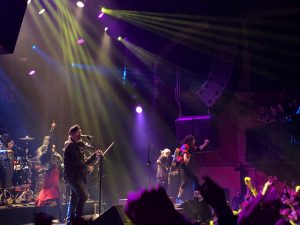
Right before New Year’s, after a dark solstice but aluminum bright Christmas, they catch Gogol Bordello at the Ogden, and see punk reinvigorated with body surfers and hyper-energy. He started wearing purple again after his son admitted his quip about purple being sign of sexual repression was just a joke. He had bought a purple vest before seeing Ella and the Count in Berlin when he was a college student. He still sported a pair of round purple frames, albeit the prescription is outdated. To have seen Gogol Bordello sing “Start Wearing Purple” when the band opened for QOTSA at Red Rocks. Colors were ok again – goth was never in play, but fashion and gallery black a perennial option – and the “Did It All,” mostly on own, although she cries about her model of father and crazy mother when she hears Lutheran hymns. He thinks his mother would have liked the energy of Gogol Bordello the way she liked Elvis Presley. Can’t say what the wayward paterfamilias might have preferred. (2018)
Wax Trax and Roxy
I would walk from my flat on Quality Hill to the Argonaut on Colfax, and always took shortest route once found it. From Tenth and Downing, I would zigzag the blocks to Thirteenth and Emerson; across the schoolyard to Fourteenth; through parking lot back of St. John’s; on new Argonaut parking plane. This I knew to be the best route, for when you crave liquor, the straight road is the kind road. (I never drive to treat a vice.) If I hadn’t bumped into a fellow sporting a torn khaki shirt and a Roxy button at a Valley party near Boulder, I might never have known, at least not so soon, of Wax Trax, a record store first located at Thirteenth and Ogden. I missed it on my beer runs; oh, how I’ll miss it now, with their relocation to Chicago. Before this drunken redhead Dannie informed me that store in Denver that catered to the English sound, I knew there was some Roxy crowd around, after paying heed to bunch of leather-jacketed high-heeled rockers storming it Broadway after the Bowie concert. The buttons were all Roxy, what a nice surprise, since I thought I was informed, just new to Denver from a stint in Chicago. It was underground the word of mouth let you pleasure. But right here in Denver – growing up here like call it my town – was music to glue to aboveground. You must realize David Bowie brings the tar out of his fans.
– circa 1978
With Bowie dead time to catch concert, with other “sentimental fool” Bryan Ferry, live at Paramount August 3, 2017: http://www.denver-theater.com/theaters/paramount-theater/bryan-ferry.php
Denver Dog Tales