“Winter Solstice 2014”
The longest night for Clarissa Dalloway was the Great War, when “great” was a word used not to describe confirmation, but rather size, bigness, the first world war. Then there was the flu in 1918, and she suffered through that purge, and she just wanted to have a party. We commemorate the beginning of the First World War with fields of red porcelain poppies. Clarissa just wanted to “decorate the dungeon with flowers.” At her party, she was upset that someone mentioned death — a doctor mentions a shell-shocked vet who had thrown himself out a window. Clarissa feels what he feels, the liberation of death, and we might consider that Virginia Woolf was identifying with soldiers who were suffering through the depression that she felt her whole life. It is the longest night, the shortest day, when we feel this way about life, but Clarissa celebrated with a party, trying to avoid “her disaster — her disgrace. It was her punishment to see sink and disappear here a man, there a woman, in this profound darkness.”
The darkness of the night can be compared to the big sleep of death, but many characters in literature look toward the waning light in the West, as a chance to redefine who they are. Huck Finn fakes his own death so that he can be free of his Pap, and free of civilization, but he encounters a friend, Jim, a runaway slave, and he commits to securing his freedom. They float down the Mississippi at night, naked and hot, hoping not to be caught. Huck wanted freedom, but sees that he has to care for a man who is hunted. In these adventures, the dark embrace of the big muddy allows us to circumvent authority, to navigate our salvation through our personal Hades. For his final adventure, Huck has “got to light out for the Territory ahead of the rest” because Aunt Sally was going to civilize him, and he’d been there before. Mythic heroes seek understanding by traveling blindly, wandering lonesome, and renegotiating the meaning of home, with its social consequences. They travel through some dark encounters tailing the fading light.
James Joyce finished his Dubliners series of stories with “The Dead,” which heralds another party, this one on the Epiphany, the feast day when the Wise Men saw the light. Gabriel Conroy laments that one of the hosts of this annual winter celebration, his Aunt Julia, will likely die soon, after seeing her haggard but hearing her sing in flight for her guests. After the party, Gabriel longs for an intimate night with his wife in the hotel where they are staying, but finds that she is thinking of a young love of hers who was ill and died soon after singing to her on a cold, rainy night. With these thoughts at hand, Gabriel thinks that his wife Gretta has had that great love in her life, and how poor a part he had played as her husband. Gabriel looks out the window and sees the snow “thickly drifted on the crooked crosses and headstones,” and his “soul swooned slowly” over the souls of the dead who inhabit the western shores of lands forever turning on the globe. He hears “the snow falling faintly through the universe and faintly falling.” Gabriel Conroy cries for his love as his soul approaches the region of the dead. Huck Finn is headed out west, to be his own man. Clarissa Dalloway must get back to her party, “but what an extraordinary night,” she thinks. They all sense the darkness, yet seek the light waning that will wax again, where the rosy fingers of dawn await us.
“Winter Solstice 2015”
I see you all regardless
I know what lies are like
I might have been born yesterday, sir
But I stayed up all night
-El-P
This is one of those nights. The long nights when we claw at the winding sheet, crave the day. We want people to know what the night dispels. We don’t want to disappear; we want to connect with our ancestors and descendants.
Marlowe tracks Kurtz in Joseph Conrad’s Heart of Darkness to a “colossal jungle, so dark-green as to be almost black”, where the id, the subconscious rules. Kurtz is rumored to have written, “Exterminate all the brutes,” but we don’t know who the brutes are. On the longest night we delve deep to identify them — are we the brutes? “The horror! The horror!” We seek society to avoid the fall.
Janus, the Roman god of gateways, of beginnings and ends, looks both ways — back to the Fall, forward to the Spring. But these are new seasons, the transitions. There’s really just Summer and Winter, light and dark, the longest day and the longest night.
The Winter Solstice inures us to the coming cold with an offertory of longer days. Still, we want to slam the night shut of dingy shades, the stomping of the feet, crossing the river and the vacant lots where our ancestors — the settlers, senators, and soldiers — gather at Riverside. We project ourselves across the Platte, the river Styx, hoping to save Heorot from Grendel.
Ironton is our Heorot, the great tavern from the epic poem Beowulf. Where people meet, greet, garden, drink, and come a community. Who is our Grendel, in this longest of nights — not the developers, not the traffic barricades, but our solo selves. RiNo elevates us hidebound to welcome the lengthening. We can cross this frozen river, where the slush undermines our feet. It’s a long night to struggle through, but Solstice suggests that there are more people, places, and histories to discover.
Seneca, the Roman Stoic, considered an asthma attack a rehearsal for death, as he gasped for breath hoping it would not be his last. We want those extra breaths. So, too, getting through the Winter Solstice is like testing a Tempur-pedic for the Big Sleep — their ads say, “sleep like the dead.” We rehearse from birth to death, sleeping heavy and rising light, especially on this night.
Let us recall what Dylan Thomas advised, the poem read as his eulogy:
Do not go gentle into that good night,
Old age should burn and rave at close of day;
Rage, rage against the dying of the light.
Though wise men at their end know dark is right,
Because their words had forked no lightning they
Do not go gentle into that good night.
“Winter Solstice 2016”
Since my retirement in June, I’ve been exploring the afterlife. As a teacher, I slept seven hours a night, waking at 4:30 to read before work, to wake up my mind. Now I awake at 4:30, but turn over for two hours, to dream, to re-imagine my life, to have contact with people who have passed but who in their afterlife talk to me. We all share alternate lives in the subconscious of our sleeping hours. The winter solstice affords us more time than ever to follow the narratives of our dreams. Sigmund Freud became a great storyteller in making connections between people’s psychoses and the subconscious cravings revealed in their dreams. He followed the narrative.
The afterlife is the legacy and memories that people we have known bring to our subconscious lives. My sister Eileen thanked me the other night for explaining the word “surreal” to her: she was in the back seat of the brown ‘49 Chrysler that my mother owned; my sister Marylyn was driving and Mom was on the passenger side of the front seat. Eileen thought their conversation and intention to buy flowers for spring planting was surreal. To my knowledge, I never explained “surreal” to Eileen, and I can’t imagine a scenario like this, although the three of them were in character. My mother died twenty years ago, and Marylyn and Eileen 15 and 13 years ago. It was nice to see them again.
The solstice sleep is like crossing the seven-mile bridge in the Florida Keys — you get to the lower Keys, beyond the scope of reality; you are at the end of the world, where the dead freely cavort with the natives. Lewis Mumford, a man of letters who wrote about urban planning, said that his only transcendent experience was crossing the Brooklyn Bridge at dusk, when he was in his twenties, back in the 1920s, when most of his friends were having transcendent experiences on a regular basis. The elongated dark sleep of solstice transcends the routines of our lives, and persuades us to introduce other acquaintances into our alternate realities. There are city streets, alleys, and gardens that I only visit in my dreams, as they don’t exist otherwise. They nonetheless produce experiences that friends from the past inhabit, and I have for years taken many of these narratives for real. Joan Didion in her essay “The White Album” says, “We tell ourselves stories in order to live…. We live entirely … by the imposition of a narrative line upon disparate images….” Our dreams are vital in establishing, reinforcing, and revisiting our narrative lifelines. I will lie awake for hours in the middle of the night, interpreting the thoughts that drift through my consciousness as I sometimes slumber, other times toss. This no longer impresses me as a problem, but rather an opportunity to negotiate time with people in places otherwise inaccessible to me. As my fingers and toes tend to curl over each other more and more, I find that in my dreams I can unknurl them, and they become the digits that point my hull of a corpse in the right narrative direction. All those people and places that are gone are singing in their afterlife, in my long solstice sleep, singing “Dream a Little Dream of Me.”
“Winter Solstice 2017”
Everyone needs to enter their own private black hole now and then. Where is your lair? What caverns do you spelunk; what oceans do you dive deep; what culverts do you crawl? We crave the darkness for its lack of landmarks, direction pointers, when we are seeking new directions. It’s a risk. We need it to live. And in your own private worm hole, memories and hopes merge as bitcoin currency. The solstice days from years past at Ironwood, and from years in the future on a different planet, play at 33 and 1/3 for us today in this dark night, on this wisp of a waxing moon night, this Winter Solstice, 2017.
How many people drove hours and days to celebrate the darkness of the day, the black hole sun of the total eclipse this past June? We beheld darkness in a new way, not total or directionless, yet there were disconcerting moments in the experience. The darkness rushed us from the northwest, and then engulfed us rather than setting the sun down slowly. Erie, holy, mesmerizing for its negative outlines and reverse outlook, not unlike tripping, but the buildup, feedback, sound loop gave a lot of it away. We wanted it dark, but there was little risk — just buy an extra gas can if you were worried.
The Winter Solstice we can plan on, and we know that we can reserve much of the night to ourselves. We can reorient ourselves, but that necessarily derives from a stolid sense of self, since in the dark the directions are murky, the dimensions are shifting — build out from your core. Spin the bottle. You don’t need the flaccid resolutions of auld lang syne. Take your iPhone into the basement of the House of Leaves, where the inside dimensions of the house are bigger than the outside dimensions.
Donna and I toured Havana this fall one week after Maria hit the islands. El Malecon winds along the coast, a roadway and esplanade that draws residents and tourists to the shore. Second night there, we took a cab to the Hotel Nacional, and walked to the old town, some five miles of ducking in and out of neighborhoods with glimpses of the Gulf. The major damage we witnessed were light poles down. We walked on the dark side of the street, next to buildings built over the last two centuries, many blighted. All access to the roadway and esplanade was restricted. The sinuous road let us stumble through Havana where no tourists roamed and where we wandered in an unpredictable fractal direction. One of our guides told us that there were few streetlights in Havana to enhance its romance; she would not confess to the failing infrastructure. We roamed a city new to us, known only from movies and books, in the dark, amongst strangers, feeling not quite safe, still secure in our tentative steps.
This solstice celebration shifted from the fiery pours of Ironton, the creative industrial core of River North, to the dark canopy of the forested Glens. Both places offer us a darkness to explore. The Puritans feared science for its pursuit of godlike perfection, so Ironton’s original purpose might have been suspect. They also feared the forest, where Hawthorne wrote that Young Goodman Brown encountered Goody Cloyce, one of the Salem witches. So in these Glens, among these trees, there’s a different darkness, one that our most Puritan of songwriters Bruce Springsteen describes by enjoining, “I’ll be there on time and I’ll pay the cost/For wanting things that can only be found/In the darkness on the edge of town.” Explore your times and spaces tonight — you’ve got the darkness.
“Winter Solstice 2018”
You want it darker….
We traveled to Tunisia after I received my diving certification in Ustica, a former prison island off Naples. I was getting used to the claustrophobia of swimming with the fishes, but was unprepared for a nighttime walk through the souks of Tunis. We strolled through the Medina to get to a restaurant of white tablecloths and overt service. Rather than take a taxi back, we entered the souks after dark. Pitch black through covered alleyways, we carried on albeit we flinched at any sound. It got darker before we found the streetlights of the main boulevard of the city. It was our dark night, clutching each other, where nothing happened.
There are 67 days of darkness in Barrow, Alaska, with the solstice occurring about midway through the long night. I just watched Hold the Dark, a movie about wolves and their spirits possessing a couple that sacrifices a son to survive the long cold night.
You want it darker….
Who claims the darkness over the light? The wolf, the werewolf on the full moon, the raccoon, the skunk, the nocturnal wild things that seek the sewers, the crawl spaces, the dark river courses and railroad tracks that cross our crime lit cities? What about the people who live under the viaducts, along the banks of the South Platte and Clear Creek? Do they prefer the dark to shield their suffering?
A passage from a short story by James Baldwin, “Sonny’s Blues,” has long impressed me with its foreboding darkness:
This was the last time I ever saw my mother alive. Just the same, this picture gets all mixed up in my mind with pictures I had of her when she was younger. The way I always see her is the way she used to be on a Sunday afternoon, say, when the old folks were talking after the big Sunday dinner…. And the living room would be full of church folks and relatives. There they sit, in chairs all around the living room, and the night is creeping up outside, but nobody knows it yet. You can see the darkness growing against the windowpanes and you hear the street noises every now and again…. For a moment nobody’s talking, but every face looks darkening, like the sky outside…. Everyone is looking at something a child can’t see…. The silence, the darkness coming, and the darkness in the faces frightens the child obscurely. He hopes that the hand which strokes his forehead will never stop — will never die….
But something deep and watchful in the child knows that this is bound to end, is already ending. In a moment someone will get up and turn on the light. Then the old folks will remember the children and they won’t talk any more that day. And when light fills the room, the child is filled with darkness. He knows that every time this happens he’s moved just a little closer to that darkness outside. The darkness outside is what the old folks have been talking about. It’s what they’ve come from. It’s what they endure. The child knows that they won’t talk any more because if he knows too much about what’s happened to them, he’ll know too much too soon, about what’s going to happen to him.
That’s Baldwin capturing a scene of darkness that many people still experience. Sam Cooke wrote a song inspired by “Blowin’ in the Wind” that became an anthem for the Civil Rights Movement — here are two verses:
I was born by the river in a little tent
Oh and just like the river I’ve been running ev’r since
It’s been a long time, a long time coming
But I know a change gonna come, oh yes it will
It’s been too hard living, but I’m afraid to die
‘Cause I don’t know what’s up there, beyond the sky
It’s been a long, a long time coming
But I know a change gonna come, oh yes it will
And Leonard Cohen sang this song before he died two years ago:
There’s a lover in the story
But the story’s still the same
There’s a lullaby for suffering
And a paradox to blame
But it’s written in the scriptures
And it’s not some idle claim
You want it darker
We kill the flame
The paradox is the long darkness before the light; a change gonna come.
“Winter Solstice 2019”
A common technique that students employ in essays for standard tests or applications to colleges is the citation of a word and its definition, to jump start revelations about their combustible selves. I have seldom stuck to the meaning of solstice per se, but rather reflected on its multiple suggestions: the longest hour, darkest night, or big sleep of dreams. Let’s look at the word for its simple meanings….
I won’t use a dictionary to seek its etymology – I’m loathe to do that, prefer to make up my own meanings. Consider the syllables of SOLSTICE.
The first sounds like SOUL, that ethereal thing we associate with religion and grace, the unfathomable sense of being; and solSTICE, a stick, or stitch, or stirring, something that penetrates, weaves, or shakes the cocktail decanter of the soul. I like SOUL STIRRER, and so did Sam Cooke. He first came to fame as a member of the Soul Stirrers, a gospel group that gave it up for Jesus, before Sam went secular, and started singing about chain gangs, the cha cha, and not knowing much about history — always a personal favorite since it was about love beyond academics. This brings me back to last year’s solstice words, and what has come to be his most beloved song, “A Change is Gonna Come” which ranks with “The Times They Are A’Changing” by Bob Dylan for the reality of its strained but sustaining hope. Sam was talking about racial strife, getting refused a room on tour. I quoted two verses of this song last year, but it bears listening to.
Let’s together stir our souls for the change that’s gonna come with the longer days ahead.
“WinterSolstice 2020”
I am not the person who reflected much on his life, until retirement when I started reading my old writing — I was so much older then than now — pondering who that person was who wanted to put into words what he was feeling, who needed that expressive release. In college in the early 70s everyone was reading a slew of books on self actualization, and the educated appraisal was that individuals needed something in their lives to strive towards, hanker after, believe in. I tended to think that plenty of people lived their entire lives doing what they could to survive, without a belief system. Religion was another social construct, god was dead, and although Victorian novelists attempted to come up with a progressive social system, I found their version only slightly more instructive than religious doctrine. I suppose I was an agnostic, an existentialist, a humanist. Leave the philosophizing at “Do unto others…,” so I deduced.
Having seen the destructive influences of religious fervor, and recognizing the Whole Earth Catalog as a new type of Bible, many people of my generation turned towards the ancient analogy of living side by side, inherently absorbed by the earth and solar system’s processes. Many people turned towards StoneHenge, ley lines, and astronomic conjunctions. I turned towards the earth and became a gardener, always the practical lifer I was. But over the last few years as I pondered my old letters, and wrote a yearly Solstice narrative, I have found myself deliberating on the decisions I have made in my life. The long night of the Winter Solstice gives us time to think about the road less travelled that has made all the difference.
This Solstice is different, because most of us have had months to dwell on our lives — this night of nights has lasted for half the year of 2020, as we await the outcome of life and death commingling, of parish representation. I have been writing about what it meant not to know my father, which has never been on my mind until now. How did it change my life, for better or worse? What was the alternative, the betterment? Do we find it in gardening or philosophizing? This night could be the transition, the curve that straightens out that long and winding road. You can think about this, or just live it, but your reflection might make you wonder if you’ll ever get back to where you once belonged. Or whether you want to.
“Winter Solstice 2021”
So the other night I woke up on one of the longest nights of the year and found myself remembering every moment in my life because you need a big sleep to recall it all except I couldn’t place where I had seen Hildy and Mickey the dance director at my old school until I asked D when I woke up — it was at MM’s ceramics studio on Santa Fe at their members’ holiday show — but except for that I remembered everything like when D first met my sisters in Wash Park for a summer party and she thought they figured she was robbing the cradle but my sisters are gone and I’m the one getting all the surgeries, learning how to walk down that slippery staircase in our house, no, I wasn’t a rockabye baby in a treetop thinking over my entire life like when I told my school administrator after I announced my retirement to stay out of my classroom the rest of the year, I didn’t need her suggestions regarding my teaching, or receiving 70 marones out of 100 on a paper I wrote at Oxford thinking that was a poor showing only to be told that was the equivalent of an A, and then I reminded myself of the design I created for an apartment complex in Shelburne Falls when I attended design school that featured a clothes line flying high from the roof of the complex with colorful drapes like a Turkish bazaar, lo, it was only an exercise; or, how should I drape the white camouflage fabric D and I scored from the art house behind the Ace Hardware on 38th, more Cristo wrapping, which made me think of all the gifts I wrapped Christmases past with window screening and posters of Bayer’s articulated wall and towels tied with wire where the wrapping often meant more than the junk store finds we were handing friends, and the time I dumped some barbecue coals on a pile of junk wood out back of our house only to find a fire that night which I doused with a hose, or the time on July 4th when a neighbor’s errant firework set a tree next door ablaze and I coupled all my hoses and sprayed it down until the fire department showed up and told me I was doing a fine job just finish it, then there was the time DR bon fils set the stone garage across the street on fire when he was playing with fireworks, just the wood doors caught a flame, so the fire starter thread led me to think abstractly about the wildfires this year and I never got to see JP in Montreal ‘cause of travel restrictions my grad school mate so I wrote him a note in the morning since it was his birthday and it coincides almost with the Solstice: I remembered the rest of my life lying awake but you don’t want to hear all that; I’ll save it for next year when the plague has passed and we can see the light. Take care brush ya hair.
“Winter Solstice 2022”
Thoughts and Prayers. It’s a stock phrase, overworn, spoken in tragedy, now being criticized for its evasion of responsibility for gun safety, disaster response, racist culpability, long nights of depression over the cataclysmic chaos in our world. The Judeo-Christian heritage of the Western World suggested that humans could rule the world, Every Body Wants to Rule the World, but we’re finding that to be a naive assumption as we encounter climate change that is man-made and human consuming.
Enough of this rant — I really want to talk about pronouns. Declaring your preferred pronouns impresses me as controversial as declaring whose land we’re currently inhabiting — I’d sooner give the land back to the terrier tribes who ran it, and I’d rather call you by your name than a pronoun, but it’s all good, whatever you prefer. No skin off my back.
I believe the same people who telephone their “thoughts and prayers” are confused about pronouns. Is it ‘my’ thoughts are about ‘your’ loss, in the familiar sense, or ‘our’ thoughts in the communal sense, on behalf of whatever tribe we identify with or seek to represent? Is it ‘your’ loss or ‘our’ loss, for the community of humankind? Is it singular or plural, or do you prefer to identify as ‘they’ or ‘them’ albeit you are an individual? If a person attaches “Prayers” to the adage, then we communicate that we reason and emote over your trials and tribulations. “Thoughts and Prayers” is shorthand for “Sorry, I can’t help, that’s the Way of the World, and Everybody Wants to Rule.” There are no pronouns of communion involved in this lament, no searching for solutions, no legislation, no salvation. It’s a perfectly selfish phrase.
Let’s turn, instead, to the reflexive “nosotros”, us or ourselves. Thoughts about how to fix our failings, miscommunications, tragic consequences. Prayers that ‘we’ are one. It’s transcendental, ecological, intersectional, connected. Say “we” in 2023, and call out those who continue to separate us in terms of I and It; relate rather as I and Thou.
I wait all year to write a few simple words for Winter Solstice. The moral: intone “Nosotros” this nocturne.
“Winter Solstice 2024”
Her longest night started weeks ago, when he called an ambulance to rush her to St. Anthony’s, the pain was so severe she couldn’t wait until the next day’s procedure. We expected to see her later in the week, after Wednesday’s appointment, but she never returned home. We expected to see her one day or another but doctors and tests and treatments took all her time and energy. They discovered cancer cells in the fluid they drained from her lung. She had been coughing since a stroke broke her after a month long bicycle tour of Italy. It was a grand affair, but the wind and rain tossed and turned them the first leg of the trip. She felt exhausted a few days the latter part of the trip. Night was coming on.
She always appreciated what I had to say for their Solstice gatherings. My writing and recitations started before I retired, but I think the stories I shared since leaving teaching may have said more to her as she contemplated and eventually retired as well. I find it hard to believe she only spent a few years seeking higher ground. She always seemed so happy, although he suggested she was struggling with her new life. It ain’t easy, but building a studio and loving him must have led her to forget her students and get on the bike for an adventure.
What an adventure, and one we should all contemplate before the Big Sleep, or in Dawn’s case, a Walk in the Woods. Two trees make a forest, which she must have believed. I wish for a grove of aspens, and maybe a few pines backing up their white trunks with knowing eyes.
Sudden I should say, like a coal train saxing across the plains, her death came quick. What did Dawn know when she said enough? We long for a message from the dead but it never arrives, never finds its Western Union bike boy. Dreams mixed with longings for those good times with all who have passed become our history of regret and grief. Take a moonlit walk in the woods while you can, stay the night, and gratefully greet rosy Dawn come morning.
“Winter Solstice 2025”
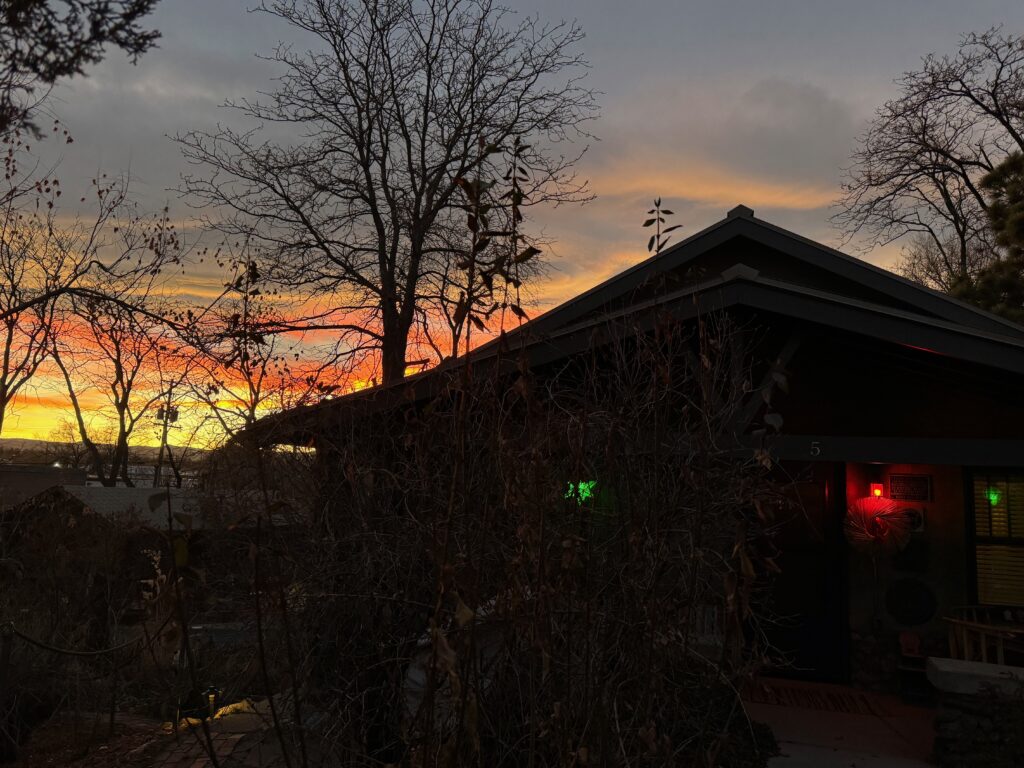
Another long night after early dusk. Old folks take photos of sunset and sunrise, to either get the party going, or remind themselves they’re alive another day. I’m 74, the age my father died, so I’ve tried to get through the year without devastating arguments or florid elegies — just carry on, and maybe last till 80 years, the split between my father’s and mother’s deaths. I never knew him, so I’m racing a ghost, mom’s example guiding me, trying to find where he went and why. He adopted my three older sisters, who all died young, their early sixties. What was his part in their deaths, abandoning them and me when I was but young, and they were in their teens? Or were their father’s genes, he who died young like them, the culpable biomix? Are any of us responsible for the choices we make in our lives, to love one and abandon another, to go for the gold, the bold, or to follow the straight and narrow? I don’t know anymore — life seems so simple and extraneous, complicated and essential. We are contradictions. Closure or resolution is impervious — no traction there.
I can still cut my toenails, scoot around town on a Vespa, ride the bike for 40 miles, garden and read, so for another sunrise in the East I fathom the horizon, and pray it’s not my last. Bring on the light and let’s get lit.